


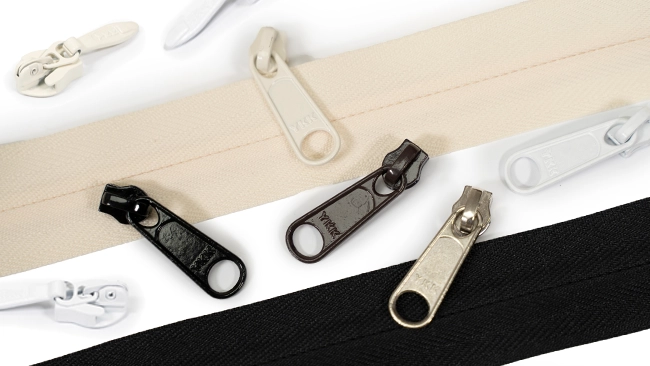
From fashion to industrial fabrication, zippers are a backbone component found in endless products. But not all zippers are created equal, and neither is the language used to describe them. Whether you're designing outdoor gear, tailoring custom apparel, or repairing a boat cover, knowing the types of zippers and their parts can make all the difference.
Ready to expand your fastening vocabulary? Let’s unzip the terminology used by professionals and hobbyists.
The Language of Zippers
A zipper might seem like a simple way to hold two pieces of fabric together. But when you're dealing with high-performance gear, rugged outdoor fabrics, or precision-built projects, it’s so much more than that. In those cases, a zipper is a key component that needs to deliver strength, reliability, and smooth operation every time.
YKK® offers a comprehensive line of zippers for different uses, all of which fall into one of three interconnected parts:
- Zipper Chains (also known as continuous chain): The interlocking teeth or coils, available in yards or rolls for custom cutting
- Zipper Sliders: The mechanism that opens and closes the chain
- Zippers (complete): A complete unit that includes both the chain and the slider, often finished with top and bottom stops or closed ends
Zippers also come in a variety of types, including coil, Vislon® (molded plastic), and metal, each engineered for specific durability and performance factors like water resistance, UV exposure, or strength. For professional builds or repairs, separate zipper components, like chains and sliders, can be purchased individually to allow total customization.
One Tab or Two? Choosing Between Single and Double Pull Sliders
When it comes to how you open and close a zipper, the style of slider you choose makes a big difference. Some applications only require access from one side, while others, like tents or marine enclosures, benefit from dual-sided functionality. Here's how to know which one you need:
- Single-pull sliders: These sliders have a pull tab on only one side. Best for standard applications where access is only needed from one direction.
- Double-pull sliders: Have pull tabs on both sides, making them perfect for tents, marine enclosures, or any project where two-way access is helpful. For example: boat windows, awnings, or soft enclosures where users may enter from either direction. See options like the YKK® Double Pull Metal Slider.
Lock It In or Leave It Loose? Understanding Slider Functionality
Sliders don’t just open and close. Some actually lock in place, while others are designed to move freely with minimal resistance. Choosing the right style depends on how you want your project to function once it’s in use. Here's the breakdown:
- Non-locking sliders: Allow the zipper to move freely without any locking action. Common in handbags, cushion covers, and light-use projects where frequent opening and closing are required.
- Auto-locking sliders: Built-in locking mechanism holds the zipper in place until intentionally moved, ideal for gear that’s exposed to movement, tension, or the elements. Think backpacks, bimini tops, marine applications, tactical gear, and safety covers.
Who Relies on Professional-Grade Zippers?
YKK® zippers in particular are chosen by industry professionals who need closures that simply won’t fail under pressure. That includes:
- Marine fabricators crafting enclosures, cushions, and biminis
- Outdoor gear manufacturers engineering rugged, weather-ready packs and tents
- Tactical and uniform designers building equipment-grade clothing for active personnel
- Medical equipment producers requiring smooth, secure closures on adaptive garments
- Industrial textile companies assembling safety or protective gear
- Fashion designers seeking precision zip functionality for garments and accessories
- DIY enthusiasts elevating personal projects with tried-and-true fasteners
For added functionality, zippers often appear alongside cord locks, d-rings, and webbing to complete adjustable closures and secure fits.
A Quick Zip Through Time: When Zippers Took the Spotlight in Fabrication
Zippers have been around longer than most people realize. Originally called the “Slide Fastener” or “Clasp Locker,” the first working version was made of eyes and hooks to help close a bag or boots and was invented in 1891 by Whitcomb L. Judson. The zipper design evolved into what we know today in 1913, when Gideon Sundback incorporated metal zipper teeth instead of hooks.
Early designs were clunky and mostly found on boots or tobacco pouches. It wasn’t until the 1930s and 1940s that zippers became a mainstream textile component, thanks to new zipper materials, better engineering, and growing demand in fashion and military industries.
Today, zippers are used across all stages of fabrication, from patterning and design to sewing and final installation. In most projects, a zipper is added toward the end of the build, once major seams are assembled. This allows for precise attachment to openings like tent doors, cushion covers, backpack compartments, or jacket fronts.
If you’re using YKK zipper chain and sliders separately, installation involves measuring and cutting the required length, adding stops, and pairing it with the correct slider and pull. For those working on weather-resistant builds, sealing techniques (like zipper tape or flaps) may also be added during the finishing stage to protect the zipper from moisture intrusion.
Zippers That Fit the Shape of Your Project
When it comes to choosing the right zipper, the shape of your application can be just as important as the materials you're using. When you're unsure which to choose, here’s the rule of thumb: Use coil zippers for curves and flexibility — use molded tooth zippers for straight, structured, or weight-bearing installs.
Best for Straight-Edge Installs
If your design runs in a straight line, like on gear bags, lounge cushions, seat backs, or awnings, go with YKK® VISLON® zippers. These feature molded plastic teeth that offer a rigid, durable structure ideal for long, linear openings.
Their strength and consistent alignment make them especially useful when you need that zipper to stay put and perform under load.
Curved or Contoured Applications
Working with curves, bends, or rounded corners? YKK® Ziplon® coil zippers are made for that. Their flexible nylon coil construction allows them to mold to contoured shapes without bunching or binding.
They're commonly chosen for boat enclosures, window panels with curves, tent flaps, and any application that requires the zipper to flow with the fabric.
Function, Fit & the Features That Set YKK® Apart
There’s a reason zippers are still the go-to closure system across so many industries: they strike the perfect balance between strength, speed, and ease of use. YKK® zippers stand apart from the rest because they’re purpose-built for performance. Whether you need an auto-locking slider that won’t slip under tension or a molded Vislon® zipper that withstands saltwater and UV rays, there’s a targeted solution available.
Here’s why pros choose YKK® over other fasteners:
- Reliability in movement: Sliders glide smoothly, even under heavy use
- Durability: Coil, molded plastic, and metal options are engineered to resist corrosion, abrasion, and warping
- Customization: Chain-by-the-yard, mix-and-match sliders, and multiple zipper pull styles allow for tailored builds
- Specialized options: Water-repellent, flame-retardant, or marine-grade zippers meet niche industry needs
- Ease of repair: Swapping sliders or replacing chain segments can extend product life
Simply put, if your project needs a secure, functional closure that withstands the elements or heavy handling, a YKK® zipper is the smart, proven choice.
How To Select and Use the Right YKK Zipper
Whether you're replacing a broken slider or building a custom zipper from scratch, a few best practices go a long way in making sure your zipper performs well for the long haul.
Selecting the Right Zipper
Tips for zipper success:
- Always match parts by size and type — pair #5 chain with a #5 slider, Vislon® with Vislon®, etc.
- When cutting zipper chain from the roll, use a hot knife to seal edges and prevent fraying
- For custom builds, add stops to the top or bottom of the zipper if you it needs defined start/end points
- Use a fabric-compatible thread and stitch pattern (like double stitching or bar-tacking) when sewing in the zipper
- Test slider motion after installation to make sure it’s smooth and not catching on fabric or seam allowances
- For waterproof or marine applications, consider adding a flap or rain guard over the zipper for extra protection
Still not sure what to order? Check out our FAQ or contact Trivantage support for help matching parts by SKU or application.
A General Zipper Installation Tutorial
Need a quick how-to for basic installation? Here’s a simplified process for installing a custom zipper:
- Measure the opening and cut your continuous zipper chain to the specific length.
- Seal the cut ends with a hot knife (for coil or plastic zippers).
- Add a slider by feeding it onto the chain, make sure it’s facing the correct direction for your project.
- Attach top stops and bottom stops if needed, using pliers or crimping tools.
- Align and pin the zipper into your fabric pieces, making sure it sits evenly.
- Sew the zipper in using a zipper foot for straight, close seams.
- Test the slider, adjust as needed, and finish any surrounding seams or reinforcements.
Where to Buy YKK Zippers and Accessories
Trivantage offers a comprehensive inventory of YKK zipper components tailored to a range of industries and applications. From continuous chain zipper rolls to individual sliders, double-pull options, auto-locking models, invisible zippers, end stops, and complete zipper sets, everything you need is right in one place.
We offer supplies in both standard units and bulk quantities, perfect for keeping your shop stocked or prepping for a large-scale build. With fast shipping, easy reordering, and quality customer service, we’ve become the go-to source for fabricators across marine, upholstery, outdoor, and industrial markets.
Explore YKK® zippers and accessories at Trivantage.com today and make sure your next project zips up just right.