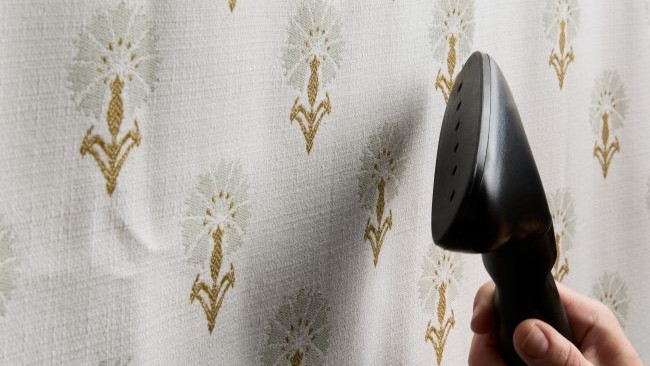
Wrinkles in thick upholstery fabric can slow production, complicate cutting, and change the appearance of a finished project. Woven acrylic jacquard upholstery fabric needs extra care because its fibers, dimensional pattern, and backing material can be sensitive to heat. Excessive heat or pressure can crush the woven pattern, create shiny areas, damage the backing, or distort the fibers. The safest method for pressing woven acrylic jacquard upholstery fabric is to steam first, use minimal pressure only when needed, and allow the fabric to cool completely.
Quick Answer: How Do You Safely Remove Wrinkles From Woven Acrylic Jacquard Upholstery Fabric?
To safely remove wrinkles from woven acrylic jacquard upholstery fabric, place the fabric face down on a padded surface, set the iron to its lowest synthetic or acrylic setting, and cover the fabric with a clean press cloth. Begin by steaming with the iron held 1/2 to 1 inch above the fabric. If creases remain, press the iron straight down for no more than 2 to 3 seconds, then lift it straight up without sliding. Allow the fabric to cool completely before moving or cutting it.
- Check the fabric manufacturer's care instructions.
- Test the method on a fabric scrap or an inconspicuous area.
- Place the fabric face down on a padded surface.
- Set the iron to its lowest synthetic or acrylic temperature.
- Cover the fabric with a clean cotton press cloth.
- Hover the iron 1/2 to 1 inch above the fabric and apply steam.
- Press briefly only if wrinkles remain.
- Lift the iron straight up instead of sliding it.
- Allow the fabric to cool completely before handling it.
Important: Always follow the fabric manufacturer's current care and cleaning recommendations. Test heat and steam on a fabric sample before treating the full piece.
Why Does Woven Acrylic Jacquard Upholstery Fabric Need Special Care?
Woven acrylic jacquard upholstery fabric differs from many cotton and polyester materials because it may combine heat-sensitive fibers with raised or dimensional patterning. Four characteristics explain why it requires gentle handling:
- Acrylic fibers can soften or distort when exposed to excessive heat.
- Raised jacquard patterns can be flattened by direct pressure.
- Latex or acrylic backings can react poorly to prolonged heat.
- Sliding an iron can distort the weave or mark the fabric surface.
Heat-related damage may be permanent, so high-temperature ironing methods are not recommended for acrylic jacquard upholstery fabric.
What Tools Are Needed to Press Acrylic Jacquard Upholstery Fabric?
Before pressing woven acrylic jacquard upholstery fabric, gather the following tools:
- An iron with adjustable heat and steam settings
- A clean cotton muslin press cloth, cotton sheet, or similar material
- A thick towel, needle board, or upholstery pad
- A clean, flat work surface
- A handheld or commercial garment steamer, if treating large yardage
A padded surface protects the raised texture of the fabric, and the press cloth creates a barrier between the iron and the upholstery material.
How to Press Woven Acrylic Jacquard Upholstery Fabric: Step-by-Step Instructions
Step 1: Check the Fabric Manufacturer's Care Instructions
Review the manufacturer's care and cleaning recommendations before applying heat, steam, or moisture. Instructions may vary depending on the fabric construction, finish, coating, or backing.
If a fabric sample is available, test the full process on the sample before working on the project material. Check the sample for changes in color, texture, shine, pattern dimension, and backing condition.
Step 2: Place the Fabric Face Down on a Padded Surface
Lay the woven acrylic jacquard fabric face down on one of the following:
- Thick towel
- Needle board
- Upholstery pad
Working from the back of the fabric helps protect the visible surface and reduces the likelihood of flattening the dimensional pattern.
Make sure the fabric is smooth and fully supported before applying steam.
Step 3: Set the Iron to the Lowest Appropriate Temperature
Set the iron to its lowest synthetic or acrylic temperature. Recommended settings are:
- Heat: Lowest synthetic or acrylic setting
- Steam: On
- Press cloth: Required
Place a clean press cloth between the iron and the back of the fabric. The press cloth helps distribute heat and moisture while reducing direct contact.
A higher temperature does not necessarily remove wrinkles more efficiently. Excessive heat can damage acrylic fibers, coatings, or backing materials.
Step 4: Begin With Hover Steaming
Hover steaming relaxes wrinkles before the iron touches the fabric. To hover steam:
- Hold the iron approximately 1/2 to 1 inch above the back of the fabric.
- Apply controlled bursts of steam.
- Allow the steam to penetrate the fabric.
- Check whether the wrinkles begin to relax.
In many cases, hover steaming can remove most wrinkles without direct iron contact.
Avoid holding the iron over one area for an extended period. Work gradually and inspect the fabric as you move from section to section.
Step 5: Use Minimal Contact Only When Necessary
If light creases remain after steaming, use minimal direct contact:
- Keep the press cloth over the fabric.
- Place the iron straight down on the press cloth.
- Hold it in place for no more than 2 to 3 seconds.
- Lift the iron straight up.
- Move to the next section.
Do not slide the iron. Sliding can distort the weave, flatten the pattern, or leave marks on the surface.
Use only the amount of pressure needed to address the remaining crease. Heavy pressure can crush raised yarns or dimensional details.
Step 6: Allow the Fabric to Cool Completely
- Leave the fabric flat and undisturbed until it has fully cooled.
- Cooling is an important part of the process because the fabric can retain its new shape as its temperature decreases. Moving, folding, stacking, or cutting the fabric too soon may reintroduce ripples or distortion.
- Inspect the face of the material only after it has cooled.
Can You Use a Garment Steamer on Acrylic Jacquard Upholstery Fabric?
Yes, a handheld or commercial garment steamer may be a practical option for large pieces of upholstery fabric or dense jacquard constructions.
When using a garment steamer on acrylic jacquard upholstery fabric:
- Work from the back of the fabric.
- Keep the steamer head approximately 1 to 2 inches away.
- Avoid prolonged steaming in one area.
- Allow the fabric to relax before smoothing it.
- Smooth lightly by hand only after steaming.
- Let the fabric cool completely before moving it.
A steamer limits direct contact and may reduce the risk of shine, melting, or pattern compression.
Follow the fabric manufacturer's instructions and the steamer manufacturer's operating guidance.
How Do You Press Backed Acrylic Upholstery Fabric?
Some woven acrylic upholstery fabrics include a latex or acrylic backing. Backed fabrics may require additional caution because excessive heat can soften, distort, or bubble the backing.
For backed acrylic upholstery fabric:
- Use lighter steam.
- Minimize direct iron contact.
- Avoid extended heat exposure.
- Allow additional cooling time.
- Inspect the backing during the sample test.
- Stop if the backing shows signs of softening, bubbling, separation, or texture change.
Damage to the backing can affect both the appearance and the sewability of the material.
What Should You Avoid When Pressing Acrylic Jacquard Upholstery Fabric?
Avoid these common mistakes when pressing acrylic jacquard upholstery fabric:
- Using medium or high heat
- Pressing directly on the fabric face
- Ironing without a press cloth
- Sliding the iron back and forth
- Applying heavy pressure
- Holding the iron in one place for too long
- Using a hot dryer to relax wrinkles
- Moving or cutting the fabric before it has cooled
- Skipping the manufacturer's care instructions
- Treating the full fabric piece without testing a sample
These shortcuts can create shine, flatten the pattern, distort the weave, or damage the fabric backing.
The Bottom Line: Steam First, Press Lightly, Cool Completely
The safest sequence for removing wrinkles from woven acrylic jacquard upholstery fabric is:
Steam relaxes the fabric. Minimal pressure addresses remaining creases. Complete cooling helps preserve the result.
Start with the lowest heat, work from the back, use a press cloth, avoid sliding the iron, and allow the fabric to cool before handling it. Most importantly, consult the manufacturer's care instructions and test the process on a sample before treating the full piece.
Trivantage is a partner for makers at every stage of an upholstery project. Explore upholstery fabric from trusted brands to find materials suited to your next project. Visit the Trivantage Resource Center for product guides and care and cleaning information. Learn how Trivantage Plus membership may support your business with benefits such as product discounts, flat-rate shipping, and complimentary memo samples. With the right materials, helpful resources, and a supplier focused on your success, professional upholstery projects can be easier to plan and complete.
Written By

Kelsey D. Fox